#838 Bad Boys (1983)

There are a lot of pitfalls present when making a film about juvenile delinquents, and the movies more often than not turn into melodramatic sap rich in gringeworthiness. Bad Boys as a name certainly had an alarming clang to it, but to my surprise the movie not only offered depth rarely seen in its peers, but realism in a way that’s neither romancing nor fetishistically violent.

Young Sean Penn no doubt deserves a nod as he once again showcases his uncanny skill to create three dimensional characters in situations where a path of the lowest common denominator was available. Luckily the script also gives him a lot to work with, avoiding most obvious clichés of the genre throughout the movie – mostly.

While the ending is not bad, it seems to me that it’s by far the most mediocre part of the movie, effectively robbing Bad Boys away from being a complete triumph.

80s-o-meter: 82%

Total: 91%

#832 Last Plane Out (1983)

Halfway through Last Plane Out I had no idea what the movie was really about, and by the end credits rolled I was even more bemused.

Taking place during the Nicaraguan Revolution in the late 70s, there’s no real story to the movie. A journalist visits Nicaragua, meets up with the powers that be, falls in love with a rebel and flees the country in the finale which, while unexciting, is definitely the most coherent part of the movie.

Jan-Michael Vincent was never my favorite actor, and here he seems extra wooden and dazed out.

80s-o-meter: 67%

Total: 32%

#831 Terms of Endearment (1983)

Terms of Endearment, directed by James L. Brooks who wrote and directed the amazing Broadcast News and brought us The Simpsons along with Matt Groening was supposed to be a treat. The reviews were positive in general and the movie had won a whopping 5 Academy Awards, one of which was for the best picture of the year.

What I saw was completely mediocre. The really interesting moments are far and between and once the conflicts between all the characters are tediously set up, the movie pulls a sleight of hand of a terminal illness kind to resolve the movie without ever actually answering any of the questions it’s been raising for the last 90 minutes. It’s this cop out approach that makes the movie feel insignificant from today’s standpoint. If the movie really had some guts, it would’ve killed its starlet earlier on and concentrated on on lives of the people left behind, instead of just bailing out.

Jack Nicholson puts on his trademark lovable jerk impression, this time creating a character that’s somewhat impossible to read and even harder to see in any kind of fruitful relationship. Brooks’ 1997 movie As Good as It Gets has a similar setup but captures the whole struggle of wanting to be a better man in a much more three dimensional way.

80s-o-meter: 70%

Total: 58%

#827 Eureka (1983)

Whenever there’s a movie that features an array of top tier talent of the era – which in Euroka’s case is Gene Hackman, Rutger Hauer, Mickey Rourke and Joe Pesci – but you have never even heard about the title, it’s tends not to be good news. The very same goes here.

It’s not that Eureka is not a good movie or without merits; right off the start it’s made clear this isn’t your average movie. The dream-like sequences of gold rush are filled with crude poetism and scenes of wealth, sex and – often graphic – death. The same tone continues as the movie proceeds to the present time, to a tropical island where the now wealthy gold miner lives his luxurious life in the vast mansion he built, Eureka.

Every character involved is presented in an underlining fashion and with strong eccentric traits, often caught up in lengthy monologues filled with pompous melodramaticism usually seen only in costume dramas. But given the context, the setting and the plot of Eureka, here they regrettably give a strong impression of a soap opera instead.

Still, credit has to be given to Eureka for its unique approach and willingness to try out something off the beaten path. It’s this kind of boldness that sometimes makes those one of the kind landmark movies — but in this case the gamble does not pay off.

80s-o-meter: 38%

Total: 48%

#826 The Keep (1983)

Based on the F. Paul Wilson’s 1981 novel of the same name, The Keep mixes up some delicious ingredients to a somewhat uneven dish.

The real star here is the atmospheric mood The Keep achieves: The movie is always just a bit off in a charmingly fashion and that right kind of eerie feeling is constantly present when inside the citadel. The haunting soundtrack by Tangerine Dream no doubt plays a bit part in this.

The Keep is also a visually solid film with some genuinely well framed scenes.

Given all this it’s shame that The Keep isn’t a great movie and the end result fall short of the appetising premise and there’s just something unfinished and unfulfilled about it all, even during the movie’s best moments.

80s-o-meter: 58%

Total: 72%

#825 Revenge of the Ninja (1983)

One of those ultra violent, banned and notorious 80s ninja movies, Revenge of the Ninja is the kind of a movie loses some of its charm with the hi-def transfer, compared to the good old grungy VHS; The super clean transfer reveals all the clumsy makeup, effects and wobbling sets without remorse – which doesn’t exactly work out for the movie’s advantage.

Now, almost 40 years after the movie was first released, all the fuss about the movie being too violent and getting banned feels hard to fathom. What is seen here is not particularly gory or cruel, and the effects are a far cry from convincing and come across more comedic than upsetting.

The choreographed fights are ok, but nothing special enough to set the movie apart. It does get a bit better (and sillier) towards the end, and it is the outrageous end showdown that kind of makes it worthwhile to watch it through. Like the case is with many martial arts movies, Revenge of the Ninja has a very limited appeal to those who are not fans of the genre.

80s-o-meter: 67%

Total: 58%

#819 Nightmares (1983)

As usual I try not to read any info about the movie I’m going to watch to avoid any spoilers. In the case with Nightmares it might’ve been a good idea for I would’ve figured out I was watching an anthology instead of a horror movie with an exceptionally hard to follow plot. When it finally dawned to me, well — you can only imagine the amount of facepalms.

This anthology consists of four short stories, based on urban legends. The first one starts off strong with a great buildup towards the end payoff. Second one is my favorite, starring Emilio Estevez as the penny arcade wizard caught in a web of a mysterious co-op machine. From hereon it’s a slight downhill with the third episode involving a priest, a killer on a 4×4 and some magical holy water that’ll save the day. The last part of Nightmares features our favorite 80s self-absorbed company man Richard Masur as the head of the family getting a special kind of rat infestation. Too bad this is the part that drags far behind the others, relying much too heavily on subpar special effects lifted straight out of 50s monster scifi movies.

Probably one of the least known of all the 80s anthologies, Nightmares is very uneven like most movies of the genre, but still definitely one of the more interesting ones, largely thanks to its strong cast.

80s-o-meter: 79%

Total: 68%

#813 Spacehunter: Adventures in the Forbidden Zone (1983)

As is the case with every movie that was a part of the early 80s 3D fad – along with the likes of Friday the 13th Part III, Amityville 3-D and MetalstormSpacehunter: Adventures in the Forbidden Zone is also best viewed in plain 2D as the 3D effect is really nothing to write to home about. When viewed in 2D the movie suffers from the usual soft transfer introduced by the stereo technology, but could very well pass as a real movie as it doesn’t push the obvious 3D scenes too hard.

This is the type of sci-fi movie that’s shot in a desert in Utah with some cars and motorcycles sloppily modified unrecognizable, and then tries to pass all this as some futuristic alien planet — a tired and lazy approach which I tend to loathe, and Spacehunter is no exception here. The set design follows the same design philosophy and although it seems a lot of work has been put in the setup, the end result is completely missing a clear vision and everything just looks like incomprehensive mess composed of random hanging wires and blinking lights.

Peter Strauss makes for a passable rogue – obviously straight out of the Han Solo mould – that may not be that memorable but still manages to outperformance the movie. Young Molly Ringwald is even more whinier than usually, but still very endearing as the feisty and mouthy orphan Niki.

80s-o-meter: 78%

Total: 41%

#803 Stroker Ace (1983)

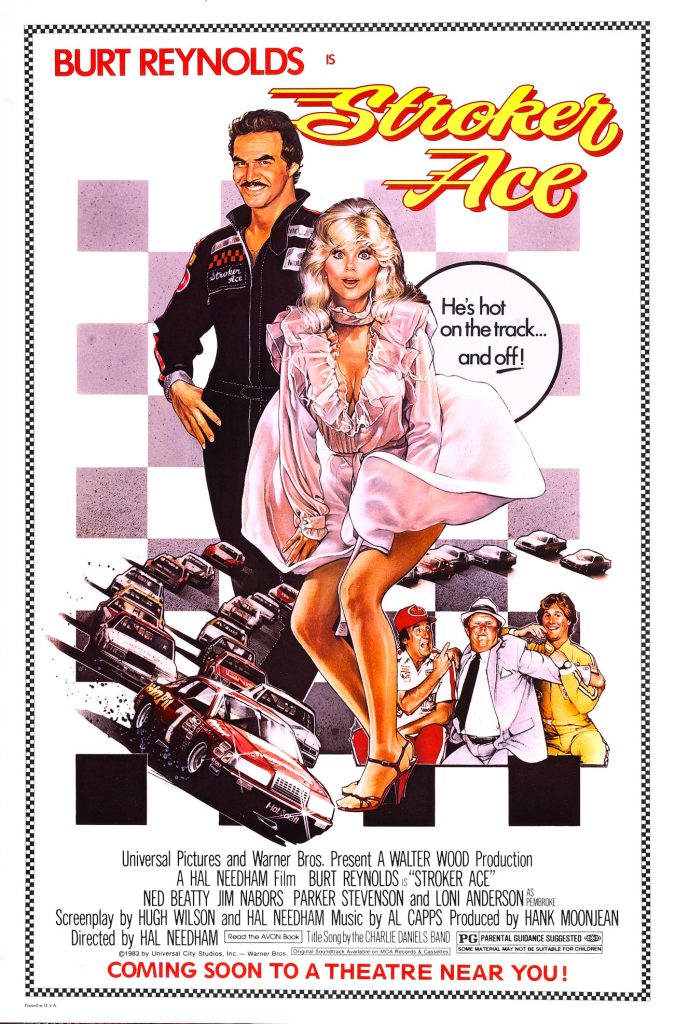
Towards the 30 minute mark of Stroker Ace Loni Anderson stands outside in the balcony with Burt Reynolds and asks him why does he keep on racing, to which Reynolds sighs and answers hesitantly — “I don’t know – it’s uh, kind of hard to explain”.

The answer would’ve likely been the same had someone asked him why does he keep on doing all these car chase movies.

Reynolds had already totally drained the genre with Smokey and the Bandit and Cannonball Run and their uninspired sequels, and in Stroker Ace he goes on to flogging the dead horse with a movie that manages to be considerably poorer than the previous ones. Once again we see Reynolds playing the slick, wise-cracking yippie ki-yay playboy head over heels in love with himself. It’s an already tired routine that grows even older 5 minutes into the film.

Directed by Reynolds’ long time mate Hal Needham – a stunt man converted to a movie maker – the movie ends with his trademark blooper reel, even which fails to amuse.

80s-o-meter: 58%

Total: 13%

#769 Flashdance (1983)

Plotwise there wouldn’t be much to Flashdance: A model working in a steel factory wants to attend to a dance school but is paralysed by her fear of trying and failing. She then falls in love with her boss, they have a few fights along the way and finally she conquers her fears and dances in the audition.

With the thin plot out of the way let’s move on to the music; and there’s plenty to love here! The highly energetic title song ‘Flashdance.. What a feeling’ composed by Giorgio Moroder and performed by Irene Cara, became a huge hit and won the Academy Award for Best Original Song. Michael Sembello’s Maniac is equally lively, and became almost as big a hit with both songs reaching place #1 on the Billboard Hot 100. Other featuring artists include Laura Branigan, Kim Carnes and Joe Esposito, and the soundtrack album went on to win the Grammy Award for Best Album of Original Score and became a best seller.

The movie is professionally shot and the camera just loves Jennifer Beals who looks absolutely gorgeous on the screen. Unfortunately, although the movie is an easy watch, it’s still nothing to write to home about, and it’s clearly the soundtrack here that gives the movie additional value – and not the other way around.

80s-o-meter: 85%

Total: 62%

#768 Strange Invaders (1983)

A scifi action adventure with just a sprinkle of horror, Strange Invaders presses all the right buttons for me genre wise.

But, the disappointment soon set in after the movie started; everything seemed somehow a bit off and not quite exactly what I’d bargained for. It was only later in the movie when I realised the obvious nod to the 50’s sci-fi movies and after putting on those black & white goggles the experience became much more entertaining – even so that I would consider watching the movie again sometimes in the future without color.

Effect wise the movie wasn’t lined up to win any awards. But, although there is certain clumsiness to the aliens hatching out of their human form, the overall effect is impactful, thanks to some sort of gooey, veiny layer implemented under the latex mask.

One could argue that Paul Le Mat is somewhat of a miscast, and the movie could’ve gained from a bit more electrifying lead. But then again, through those 1950s sci-fi glasses his act blends into the movie quite adequately.

80s-o-meter: 48%

Total: 67%

#743 Halloween 2017: The Hunger (1983)

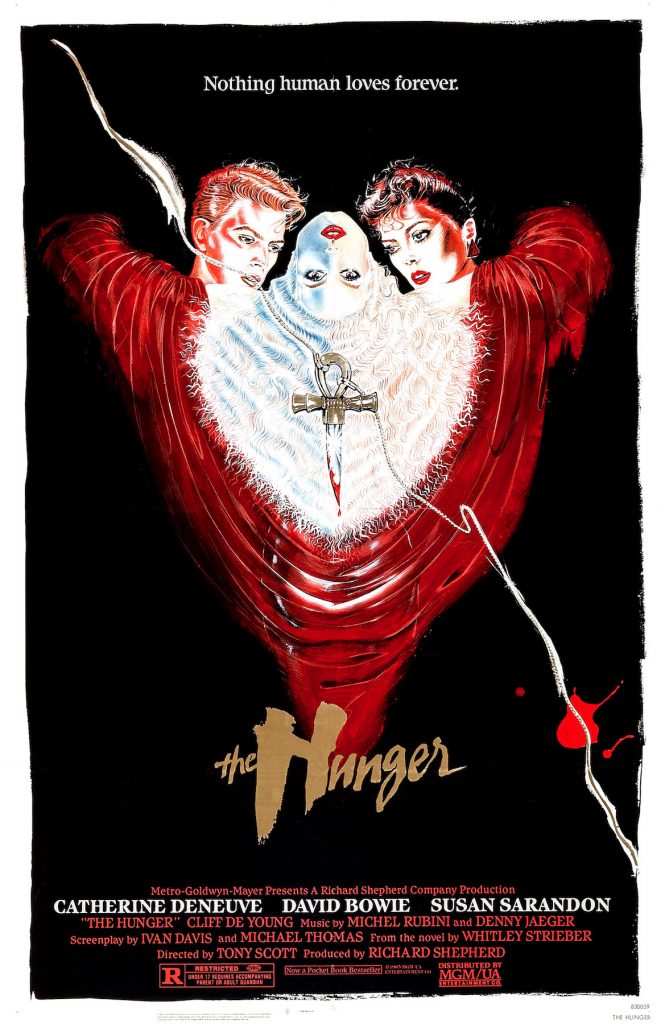
A poetic a vampire movie that never actually mentions vampires aloud, The Hunger is an artistic – and also somewhat artsy – take on the subject.

The first theatrical feature of the director Tony Scott who had earned his chops earlier directing commercials, The Hunger is a visual treat. If you enjoyed Bladerunner, chances are you will find a lot to love in the dusty and smoky, even somewhat surreal interior shots seen here. The masquerading work that turns David Bowie from a 30-year old youngster to an almost mummified old man, plus the shots towards the end of the movie of fragile old bodies to chunks of dust are extraordinarily well made and presented smartly in the screenplay. The soundtrack is also refreshingly original, consisting of haunting classical tracks and numerous unique effects that suit the atmosphere perfectly.

The Hunger is first and foremost a drama with an erotic touch, and secondly a horror movie. The visuals play a huge role creating the atmosphere that make the movie entertaining, and had they executed in a subpar manner, the plot alone wouldn’t make much of a movie here. There are certainly moments that wander into style over substance, self-indulgent territory, but even so The Hunger has that uncanny quality of sticking with you long after the end credits have rolled.

80s-o-meter: 82%

Total: 80%

#700 WarGames (1983)

Visionary both in its thematics and the execution, WarGames was ahead of its time probably in much more ways than the team creating it could ever anticipate.

In the early 80s the video and co-op games were a huge craze and were featured in many movies, but the computers were still a rare subject in a movie, and very much remained to be so for a long time to come. WarGames was not only one of the first big budget film to feature home computing, but also presented us with one curious, relatable, mischievous youngster that spent his free time phreaking and hacking into remote computer systems. And made it all a huge, exciting adventure.

That adventure quickly gets way out of hand as he manages to hack his way into a computer wired to the thermonuclear arsenal of the United States and thus capable of launching a full scale nuclear assault. The themes of balance of terror and the fear of AI turning against the humankind presented here are just as topical now as they were back in 1983 – if not even more so.

As the movie makers really did their homework with the subject and presented the hacking in believable way – more than can be said about most Hollywood movies to date – WarGames just leaves very little to improve. The great production quality holds up throughout the movie, and the end showdown with Joshua playing Thermonuclear War on the big screen is truly one palm sweating scene, as well as a visual treat.

80s-o-meter: 96%

Total: 100%

#685 Microwave Massacre (1983)

An exercise in bad taste, Microwave Massacre is an indie horror comedy about Donald, a disgruntled construction worker growing tired of her wife’s cooking first wasting her wife, and then consuming her among all the other people he manages to invite to his house.

And a true exercise it is as the movie deliberately and unshamedly aims to be as bad and politically incorrect it can be. Most of the sexist jokes are kind of useless, but some of the other dialogue that just consists of a one liner after another are funny in a face-palm shake your head kind of way.

A line like ‘I’m so hungry I could eat a whore’ as Donald chops a prostitute with an axe is as high brow as this movie goes.

Microwave Massacre is a movie so stupid it hurts to watch and you definitely have to be in a right mood for it. As a good kind of bad movie it’s just about as good – or bad – as they come.

80s-o-meter: 61%

Total: 64%

#666 National Lampoon’s Vacation (1983)

For those not familiar with National Lampoon, it was a humour magazine that ran from the seventies to the beginning of the 90s, and ventured successfully into movies in the late 70s with the hugely popular Animal House. Vacation, starring Chevy Chase, another Saturday Night Live actor was their second big success.

(with this history lesson out of the way, it’s worthwhile to note that the hugely popular Mad Magazine tried the very same thing, inspired by National Lampoon, only to crash and burn spectacularly)

It’s been a while since I last time saw the movie, but luckily it was just as funny as I remembered. What I didn’t remember was all the raunchiness, tits and black comedy elements. Mind you, it isn’t anything X-rated, but still lewd enough to safely say a saturday afternoon whole family movie this isn’t.

National Lampoon’s Vacation is a milestone in 80s comedies that inspires many other comedies still to date.

80s-o-meter: 94%

Total: 95%

#664 The Survivors (1983)

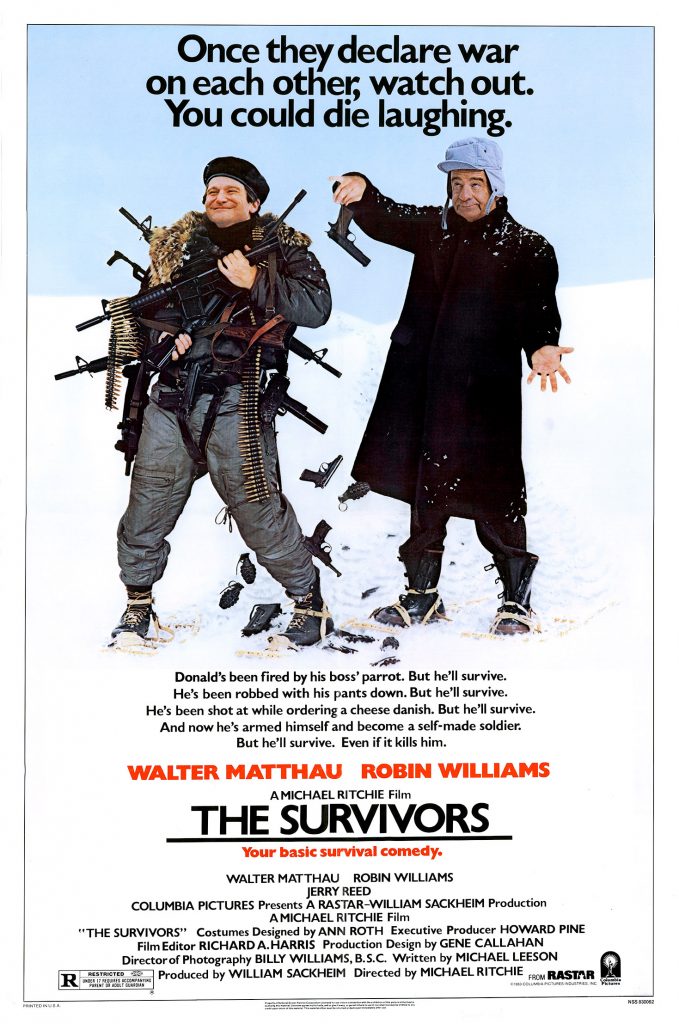
The Survivors is a comedy in two acts. In the first act we’re presented with two very different kind of gentlemen, joined together by inadvertently stopping a heist. The plot tightens when the robber returns to make sure there aren’t any eyewitnesses to send him behind the bars permanently.

This is the part of the movie that works as it is.

The second part begins when Donald (Robin Williams) joins a survivalist camp in the wilderness. While the new theme itself is an interesting and unconventional one, the tone of the movie now seems to have unfortunately changed to a less confident one: More confused and needy for laughs with a lot of more nonsense hereon to get the chuckles from the audience.

Williams’ trademark over-the-top act works here and Walter Matthau provides a quaranteed snicker with every laconic line he deliveres.

80s-o-meter: 75%

Total: 65%

#661 Joysticks (1983)

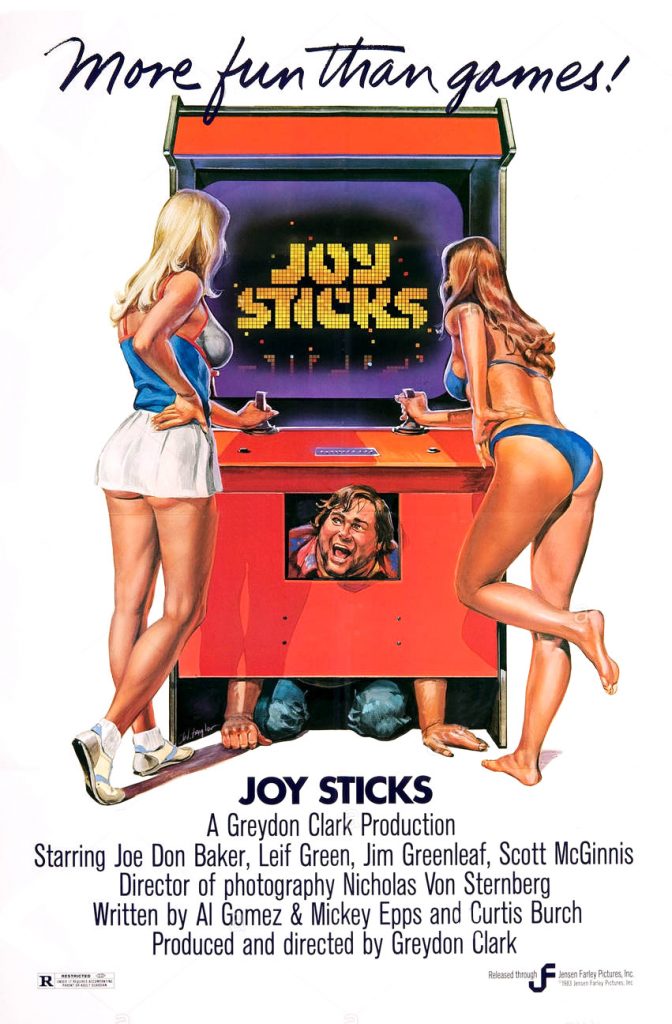
Joysticks is a movie about arcade games – but it could’ve been just as well about fidget spinners, had they been the rage at the time. The theme of the movie was selected simply to lure in teens.

And a teens movie it is in all accounts.

If you’ve seen another early 80s sex comedy like Porky’s, you know what to expect here: Tits, sexual innuendo and juvenile humour are aplenty. The movie’s vision of an arcade is a studio like warehouse with half naked teens dancing around in front of cabinets, and the jokes mostly consist of someone farting or dressing up like women.

80s-o-meter: 74%

Total: 17%

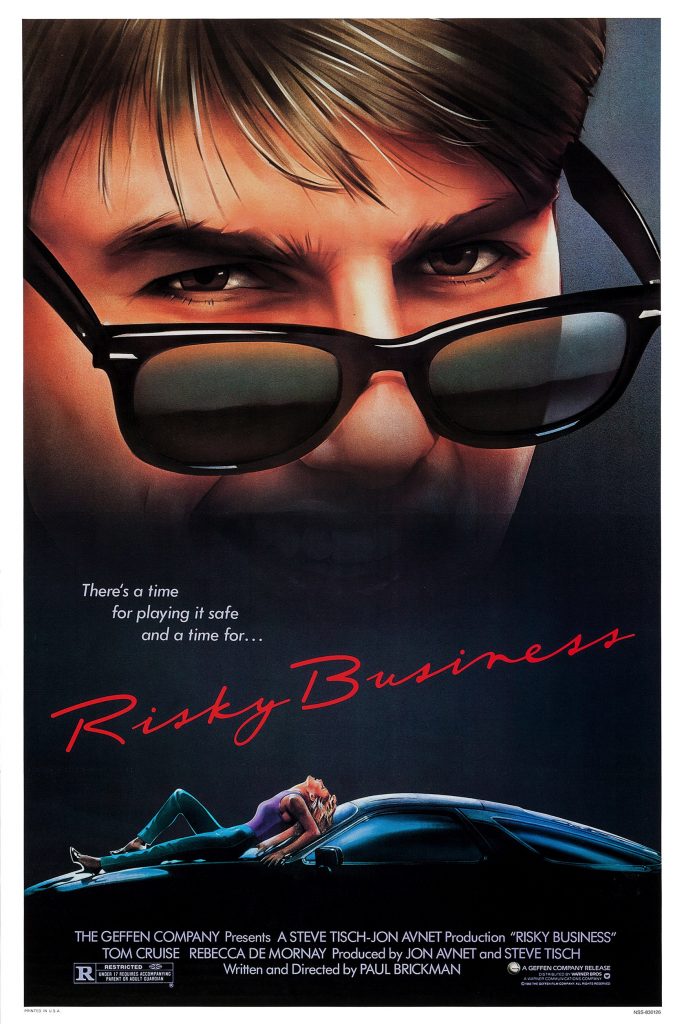
#660 Risky Business (1983)

An erotic drama thriller, sparkled sparingly with some comedy bits, Risky Business

The dreamlike soundtrack by Tangerine Dream not only compliments the dream like sequences sen on the screen, but really takes the scenes up a level or two. If this wasn’t enough, the movie pinnacles in Phil Collins’ in the air tonight,

Risky Business is a tight, powerful youth movie that leaves most of its competition miles behind and one that loses its tight focus only with its needlessly comedic ending. Until then Risky Business is a xxx, yyy and a final proof that young Thomas Cruise Mapother IV can carry a full length feature film with ease.

80s-o-meter: 90%

Total: 80%